
Study tours3 min read
Is a study tour abroad for Indonesian students worth it? What the evidence says
Study abroad experiences are linked to confidence, curiosity and adaptability, but not to guaranteed career outcomes. Here is what the research supports, what it does not, and how to judge a campus-visit programme.
By Tim Diskera, Diskera
>70%
of study abroad alumni reported significant gains in intercultural skills, adaptability, self-awareness, curiosity and confidence
IIE, 2017
>50%
of respondents believed study abroad helped them get a job
IIE, 2017
Key takeaways
- Surveys of study abroad alumni report strong gains in intercultural skills, adaptability, confidence, curiosity and self-awareness.
- Evidence that study abroad improves employment is mixed, so no programme should be sold as a career guarantee.
- Most research covers semester-long programmes, so a short campus-visit tour should be judged on what it can realistically do.
- The real value of a campus visit is a better-informed decision about where and what to study.
- Parents and schools should ask who supervises, what each day contains and who students will actually meet.
You want to know whether sending a student on a study tour abroad is worth the time and the trust it asks of a family. The honest answer is that it depends on what the programme is built to do. This article sets out what the research supports, where it is thin, and how to tell a learning programme from a holiday.
What do students gain from studying abroad, according to research?
The most cited evidence comes from a 2017 survey by the Institute of International Education (IIE) of graduates who had studied abroad. More than 70 percent said the experience significantly helped develop their intercultural skills, flexibility and adaptability, self-awareness, curiosity and confidence. More than half believed it helped them get a job.
These are qualities many families hope a young person develops: the confidence to speak up in an unfamiliar setting, the curiosity to ask questions, and the ability to adapt when plans change. They are also hard to build from a classroom alone.
What does the research not show?
The first caveat is length. Most study abroad research looks at semester or year-long programmes, and the IIE report found that longer experiences had a stronger impact on later job offers. A few days on a campus is a different thing and should not borrow those results.
The second caveat is employment. A 2019 study by Jacek Liwiński, using a nationwide survey of Polish graduates, found that students who spent at least one semester abroad did not have a higher employment rate after graduation. Evidence varies by country and method. We read this as a reason to be careful with promises, not a reason to dismiss international experience.
What can a short campus-visit study tour realistically give a student?
A study tour is not a semester abroad and should not be judged as one. Its strength is different. It lets a student stand on a campus, hear from the people who study and teach there, and test an idea of the future against reality. For many students, that is the moment a vague ambition becomes a specific question.
| It can | It cannot | |
|---|---|---|
| Direction | Help a student see whether a university, city or field fits them | Replace the application process |
| Skills | Start building independence and confidence in an unfamiliar setting | Match the depth of a semester abroad |
| Access | Open conversations with students and staff that a brochure cannot | Guarantee admission or an advantage in selection |
| Family | Give parents and students a shared, concrete reference for decisions | Remove the need for further research |
Editorial view of Tim Diskera, not a research finding.
Visit formats vary by university. The University of Melbourne's school-visit pages, for instance, describe presentations by staff, escorted tours led by students and self-guided visits, with escorted tours aimed at senior secondary students. Formats and booking terms change, so a programme should confirm them with each host directly.
How do you tell a learning programme from a sightseeing trip?
The difference is visible in the agenda. Ask these questions of any programme:
- Does the agenda start from learning goals, or from a list of attractions?
- Are there scheduled conversations with students, lecturers or admissions staff?
- Does each day leave time for students to ask questions and compare notes?
- Is the group small enough for every student to take part?
- Is there a plan for what students do before departure, such as shortlisting questions to ask?
A programme that answers yes to most of these is built around learning. One that cannot describe a typical day beyond the places on it is closer to a holiday with a school logo.
What should parents and schools check before committing?
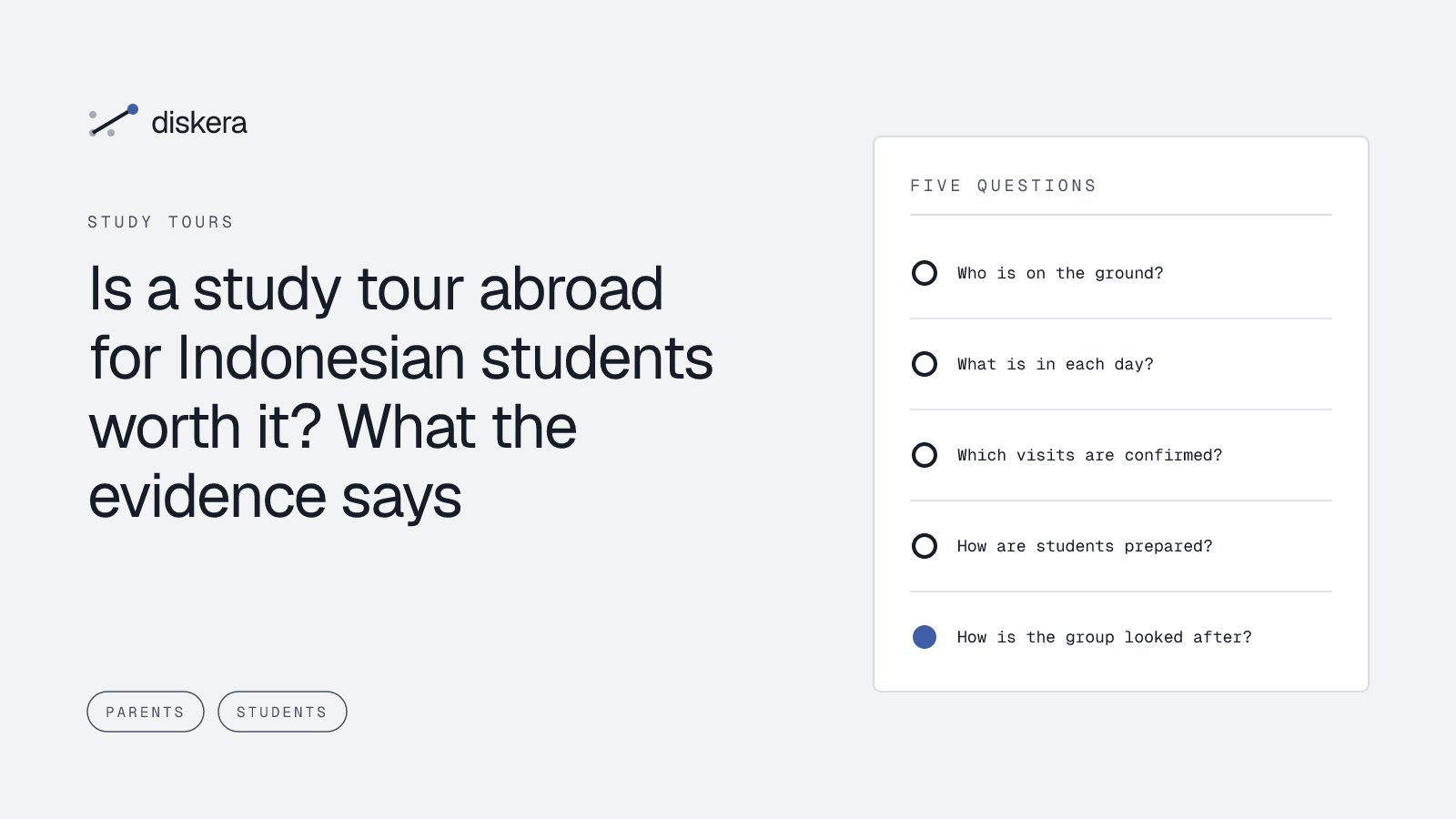
Safety and supervision come first. Antara reported that some Indonesian regional governments, including West Java and Banten, restricted school study tours over safety concerns, while the central government said it does not ban them but expects schools to ensure safe transport and teacher supervision. That expectation applies equally to programmes abroad. Five questions help:
- 01
Who is responsible on the ground?
Ask who accompanies the group at every stage and how a parent or school can reach them at any hour.
- 02
What does each day contain?
Ask for a day-by-day agenda with named hosts, not a list of places.
- 03
Which visits are confirmed?
Ask which visits are confirmed with the host and which are only planned, since host policies change.
- 04
How are students prepared?
Ask what students do before departure so they arrive with questions.
- 05
How is the group looked after?
Ask about accommodation, transport and meals, and what happens if plans change.
Written answers are better than verbal assurances. A provider confident in its programme will not mind being asked.
What does a Diskera Campus programme include?
Diskera Campus takes students on campus visits and study tours. We can arrange visits to 280+ campuses and companies across 10+ countries, shape the agenda around the group's goals, and handle everything personally from departure to return, in comfort. See Diskera Campus for how we work with schools and families.
Talk to us about a campus-visit programme
Tell us your students' goals and year groups. We will propose an agenda built around them.
Frequently asked questions
Is a study tour the same as studying abroad?
No. Studying abroad usually means enrolling for a semester, a year or a degree. A study tour is a short, guided programme built around visits, so it should be judged on orientation and experience rather than credit or academic outcomes.
Will a study tour help a student get into a foreign university?
We cannot promise that, and no honest programme can. A visit can help a student choose where to apply and prepare better questions, but admission depends on each university's own criteria.
When is a campus-visit study tour most useful?
It is most useful when a student is close enough to a decision to use what they see, for example when shortlisting universities or fields of study. Schools and parents are best placed to judge that readiness.
How do I know the hosts have really agreed to the visit?
Ask for confirmation of each host, the format of the visit and who will speak to the group. Visit formats and booking rules are set by each university or company and can change.
Who supervises students on the trip?
This should be answered in writing before you commit: who accompanies the group, how many adults are present and how parents can reach them. Ask the same of any provider you consider.
Sources
- IIE, “Gaining an Employment Edge: The Impact of Study Abroad” (2017)
- IIE, “Why Study Abroad” (accessed 21 October 2026)
- Liwiński, J., “Does studying abroad enhance employability?”, Economics of Transition and Institutional Change 27(2) (2019)
- University of Melbourne, “School visits” (accessed 21 October 2026)
- Antara, “Menimbang manfaat dan risiko study tour” (accessed 21 October 2026)