
Executive learning8 min read
Why is a corporate benchmarking trip to Asia worth it for your leadership team?
Because Asia's leading companies now set the standard Indonesian businesses compete against. A curated benchmarking programme lets your leadership team see that standard from the inside and come home with ideas, benchmarks and a shared direction.
By Tim Diskera
5 of 5
largest sources of foreign direct investment into Indonesia in 2025 were Asian economies
BKPM via Databoks, 2026
69.9%
of the global chip foundry market held by TSMC in 2025
TrendForce, 2026
280+
campuses and companies we can arrange visits to
Diskera
Key takeaways
- Asia's leading companies are now the most relevant benchmark for Indonesian businesses, because they are the partners, investors and competitors Indonesian firms face.
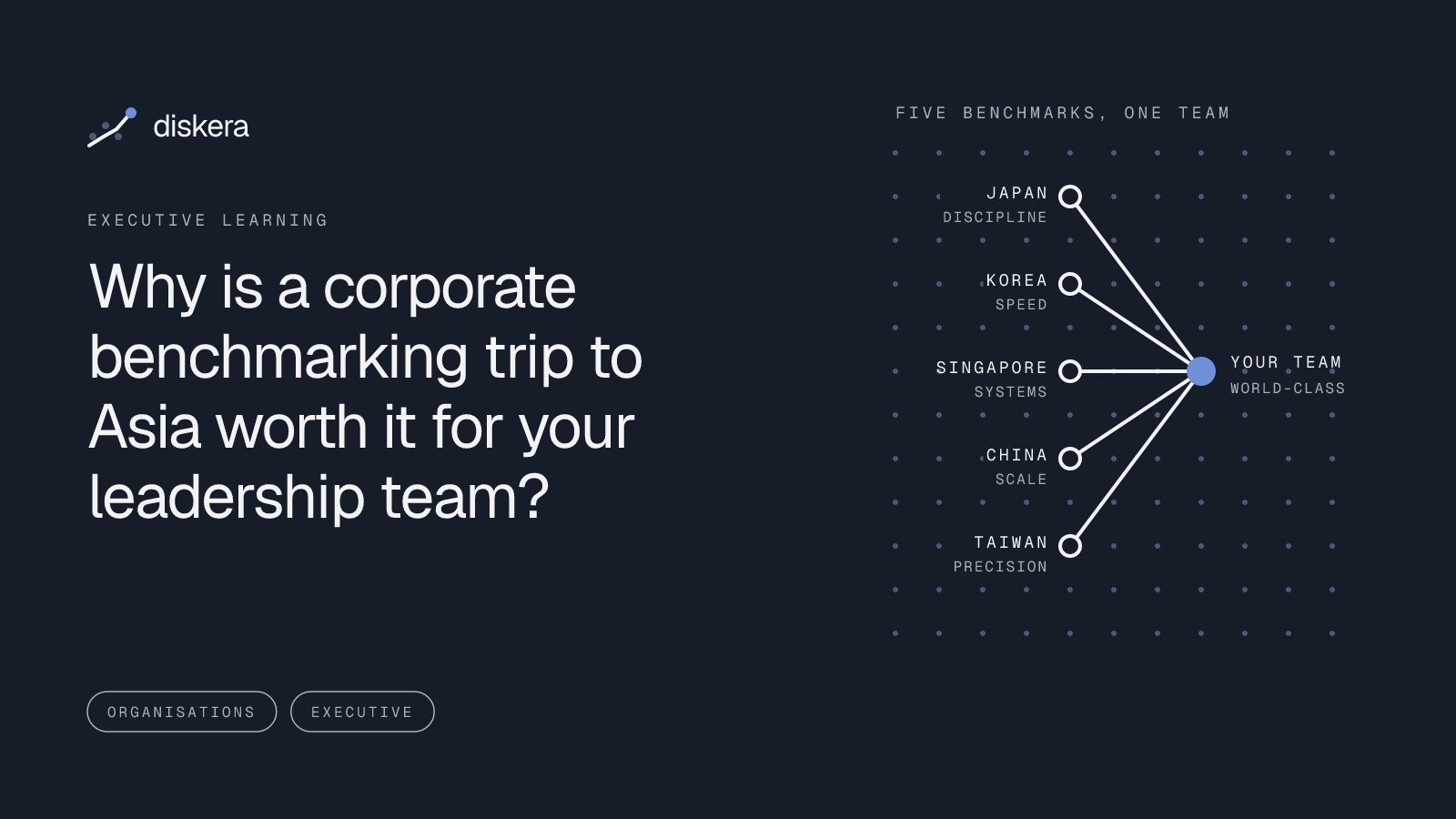
- Japan, Korea, Singapore, China and Taiwan each show a leadership team a different kind of excellence, from operational discipline to precision at scale.
- A leadership team that sees world-class standards together comes home with a shared picture of where the business should go.
- A curated programme puts your team in conversation with people inside leading companies, which a generic company trip cannot.
- With Diskera, you set the goals and we handle everything else, personally, from departure to return.
You want your leadership team to come home from a trip abroad with more than photographs: a sharper picture of what world-class looks like, and the conviction to build it here. For Indonesian companies, the most useful place to find that picture today is Asia, where companies such as Toyota, Samsung, TSMC and Alibaba have redefined what their industries consider normal. A corporate benchmarking trip to Asia, curated around your goals, lets your team see those standards from the inside and bring the lessons straight back to the business.
Why are Asia's leading companies the right benchmark for Indonesian businesses?
For a long time, benchmarking meant looking west. That has changed. The McKinsey Global Institute projects that Asia will account for more than half of world GDP by 2040, measured at purchasing power parity, and around 40 percent of global consumption. In many industries, the region is no longer catching up with the frontier. It is the frontier.
The link to Indonesia is direct. In 2025, all five of the largest sources of foreign direct investment into Indonesia were Asian economies: Singapore, Hong Kong, China, Malaysia and Japan, according to Ministry of Investment data reported by Databoks. The companies that set the standard in these economies are often the same companies that invest alongside, supply, partner with or compete against Indonesian firms.
There is a third reason, and in our view it is the most important. Many of Asia's leading companies started from conditions Indonesian leaders recognise: a fast-growing home market, limited resources and the need to compete with established global players. Seeing how they built discipline, speed and scale feels closer and more transferable than studying a company that grew up in a very different context. Your team does not just admire what it sees. It recognises the path.
What does each of Asia's benchmarks show your team?
Each economy in the region has become known for a particular kind of excellence. A well-designed programme chooses hosts for the lesson they teach, not for the fame of the logo. These are the five benchmarks we find speak most clearly to Indonesian leadership teams.
Japan: operational discipline
Toyota and Honda are the reference point for how a company turns quality into a habit. What a team takes from Japan is less a set of tools than a way of thinking: problems surfaced early, standards owned by the people who do the work, and improvement treated as everyone's daily job. Leaders who have seen it in person tend to talk about their own operations differently afterwards. We look at Japan in more depth in our article on why a corporate study visit to Japan changes the way a team works.
Korea: speed from R&D to product
Samsung and Hyundai show what happens when research, design and manufacturing move as one. Korea's leading companies are known for turning new technology into products at remarkable speed, and for making bold, long-term bets on capabilities years before the market rewards them. For a team that feels its own ideas take too long to reach customers, seeing this rhythm up close is a powerful prompt.
Singapore: world-class systems
Singapore shows what a small country can achieve when systems are designed with care and run with discipline. Changi Airport was named the World's Best Airport again at the 2026 Skytrax World Airport Awards, a reflection of how consistently it delivers a complex service at scale. PUB, Singapore's national water agency, turned a strategic weakness, limited natural water, into an area of global expertise. Both are lessons in long-term planning, public and private coordination and service design that resonate with leaders in infrastructure, logistics, utilities and the public sector.
China: scale and digital platforms
Alibaba, Huawei and Haier show how companies operate when scale and digital platforms are built into the business model from the start. Alibaba reshaped commerce and payments around the platform. Huawei built a global position in telecommunications through sustained investment in research. Haier is widely studied for reorganising a large manufacturer into small, customer-facing units. For Indonesian companies serving a vast, digital-first market, these are among the most relevant examples anywhere.
Taiwan: precision manufacturing
TSMC is the clearest example of how deep precision becomes a strategic advantage. According to TrendForce, TSMC held 69.9 percent of the global foundry market in 2025, up from 64.4 percent a year earlier. It shows a leadership team what it means to be the company an entire industry depends on, and the level of process control, talent and long-term investment that position demands.
What does your leadership team bring home?
The value of a benchmarking trip is measured by what changes after the team returns. In our experience of designing these programmes, five gains matter most.
- A shared picture of world-class: everyone in the team has seen the same standard with their own eyes, which makes the conversation about where you stand far more honest.
- Ideas ready to adapt: concrete practices from operations, product development, service or organisation design that can be tested in your own context.
- Benchmarks that stick: a clear sense of how far ahead the best are, and in which areas your company is already competitive.
- Momentum for change: leaders who have seen a transformation succeed elsewhere argue for it more convincingly at home.
- Relationships: time with people inside leading companies opens perspectives and conversations that continue long after the visit.
These gains compound when the team travels together. A single executive who attends a conference abroad returns with notes. A leadership team that walks the same factory floor, stands in the same control room and sees the same product lab returns with a common language for what it wants to build.
In our view, there is also a gain that is rarely named: confidence. Seeing that world-class standards come from choices and habits that can be built, not from some unreachable advantage, makes a team willing to set higher targets. That realisation is often where the most lasting change begins.
What separates a generic company trip from a curated benchmarking programme?
Many company trips abroad include a factory or a showroom on the itinerary. Few are designed to change how a team thinks. The difference lies in what the team is given access to, how the agenda is built and who is looking after the group.
| Generic company trip | Curated Diskera programme | |
|---|---|---|
| What the team sees | Showrooms, public galleries and landmarks | The host as its own people see it, chosen for your goals |
| Who the team meets | Tour guides | People inside leading companies |
| How hosts are chosen | By fame or convenience | By the lesson each one teaches your business |
| How the agenda is built | Around sightseeing | Around the questions your leadership wants answered |
| Care for the group | Left largely to the team | Handled personally from departure to return, in comfort |
| What the team brings home | Photos and souvenirs | Ideas, benchmarks and a shared direction |
Diskera's view of the two approaches.
A generic trip tends to leave the team as spectators. A curated programme puts the team in conversation with the host, and that is where the useful insight lives. We explore the wider case for this kind of learning in our article on what an overseas benchmarking study visit gives a company.
Which teams benefit most, and when?
A benchmarking programme in Asia is most valuable at the moments when a company is about to decide something important. These are the teams and moments where we see the greatest return.
- Boards and leadership teams preparing a transformation, who need a shared picture of the destination before they commit the organisation to it.
- Operations and manufacturing leaders who want to see quality, efficiency and process discipline at the highest level.
- Product, digital and innovation teams looking for the speed of Korea and the platform thinking of China.
- HR and L&D leaders building programmes for high-potential managers, for whom a curated visit becomes a defining leadership experience.
- Multinational teams based in Indonesia who want to match the standards their regional peers already set.
In our view, the right time is before a strategic decision, not after it. A team that has seen what is possible sets more ambitious targets and moves with more confidence once the decision is made.
Another strong moment is when a company enters a new phase of growth: opening a plant, launching a digital business line or preparing to partner with investors from the region. At times like these, seeing how Asia's leading companies met similar challenges gives the team a real reference point, not just theory from the boardroom.
What is the experience like for your team?
Picture your leadership team walking a production line in Japan in the morning, then discussing what they saw with the people who run it. A few days later they are in Singapore, seeing how one of the world's most admired airports keeps millions of journeys flowing. By the end of the programme they are comparing the two with a precision no report could give them.
Throughout, the group is looked after personally. Every arrangement, from departure to return, is taken care of in comfort, so your leaders can give their full attention to what they are seeing and to each other. The programme feels less like a trip and more like an extended strategy conversation, held in the most inspiring settings Asia has to offer.
“The best benchmarking visits do not hand a team answers. They raise the bar for the questions it asks.”
What does a Diskera Executive programme include?
Diskera designs and runs curated study visits and benchmarking programmes for Indonesian companies and agencies. We can arrange visits to 280+ campuses and companies in 10+ countries, including Toyota, Honda, Samsung, Hyundai, Changi Airport, PUB Singapore, Alibaba, Huawei, Haier and TSMC. Every programme starts with one question: what should your team understand by the time it comes home?
- 01
You tell us your goals
The business challenge in front of you, who is travelling and what you want them to see.
- 02
We curate the hosts and the agenda
We choose the companies that answer your questions and shape every session around them.
- 03
We handle everything
From departure to return, every arrangement is taken care of personally, in comfort.
- 04
Your team takes it all in
Your leaders arrive focused, meet the people inside each host and come home with ideas they can use.
Learn more about Diskera Executive, or tell us what your leadership team should come home with.
Show your team what world-class looks like
Tell us your goals and who is travelling. We will curate the companies in Asia and take care of everything else.
Frequently asked questions
Who is a Diskera Executive benchmarking programme for?
Leadership teams, boards, HR and L&D leaders and functional teams in Indonesian companies and multinationals based in Indonesia. It suits any group that wants to see world-class practice before an important decision or transformation.
How is this different from a regular company study tour?
A regular study tour is usually built around sightseeing, with a factory or showroom as one stop among many. A Diskera programme is built around the questions your leadership wants answered, with time alongside people inside leading companies and every detail handled personally.
Can the programme be tailored to our industry and goals?
Yes, that is the point of it. We choose hosts for the lesson they teach your business, whether that is operational discipline, product speed, service systems or digital scale, and shape each session around your goals.
Which companies in Asia can our team visit?
We can arrange visits to 280+ campuses and companies in 10+ countries, including Toyota, Honda, Samsung, Hyundai, Changi Airport, PUB Singapore, Alibaba, Huawei, Haier and TSMC. Tell us your goals and we will recommend the combination that serves them best.
How do we get started?
Contact us with the challenge your team is facing and who you would like to bring. We take it from there and come back with a programme designed around your goals.
Sources
- Focus Taiwan, “TSMC rides AI wave to net nearly 70% of global foundry market in 2025” (13 March 2026)
- Databoks (Katadata), “Top 5 Foreign Investor Countries in Indonesia 2025, Singapore Dominates” (19 January 2026)
- McKinsey Global Institute, “Asia's future is now” (July 2019)
- Passenger Terminal Today, “Singapore Changi retains World's Best Airport title at 2026 Skytrax World Airport Awards” (March 2026)