
Benchmarking7 min read
Why is an overseas benchmarking study visit the best investment in your leaders?
Because leaders change when they see it for themselves. A curated overseas benchmarking study visit brings home a new standard, concrete ideas and a shared conviction that no report can deliver.
By Tim Diskera
70%
of leadership learning comes from challenging experiences
Center for Creative Leadership, 2025
280+
campuses and companies we can arrange visits to
Diskera
10+
countries across Asia, Europe, the Middle East and beyond
Diskera
Key takeaways
- An overseas benchmarking study visit resets your leaders' sense of what world-class performance looks like.
- Seeing a practice working builds the conviction to act, which reports and slide decks rarely do.
- When a whole leadership team sees the same thing together, internal debate turns into shared resolve.
- The gap between a sightseeing trip and a curated programme shows in what the delegation brings home.
- With Diskera, you set the goals and we curate the hosts and handle everything from departure to return.
You want your leaders not only to know that a better way of working exists, but to believe they can build it at home. That kind of belief rarely comes from a boardroom, a slide deck or a report, however thorough. It comes when a team sees for itself how a world-class organisation works from the inside, and that is exactly what a well-curated overseas benchmarking study visit delivers.
What does a delegation actually bring home?
The value of a study visit is not measured in photographs outside a famous headquarters. It lies in what changes in the way your leaders think and decide once they are back. In our view, four gains matter most.
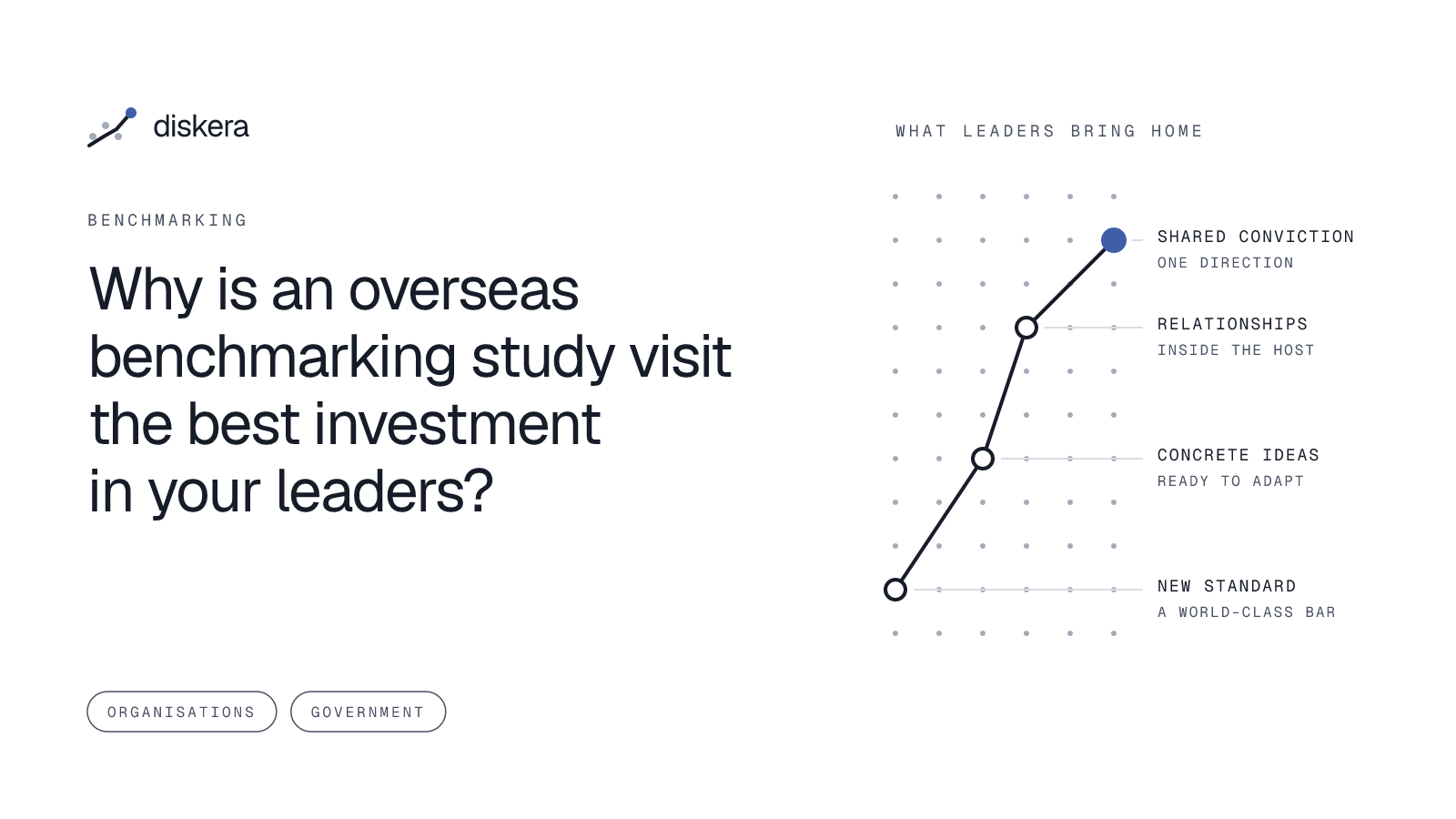
- A new standard: the team sees what world-class service, operations or governance looks like, and the bar for "good enough" rises across your organisation.
- Concrete ideas: not general theory but real practice you can adapt, from how an airport designs the passenger journey to how a factory removes waste.
- Shared conviction: when the whole leadership team sees the same thing at the same time, internal debate becomes a common resolve to move.
- Relationships: conversations with people inside the host organisation open perspectives and connections you will not find on any website.
The four reinforce each other. A new standard without shared conviction stops with one person. Concrete ideas without relationships are hard to develop further. A well-designed programme delivers all four at once, in a single journey.
Why does seeing it beat reading reports or hiring consultants alone?
In his state address of 16 August 2019, President Joko Widodo asked why officials needed to travel all the way abroad for study visits when the information was available on a smartphone. He had a point about one thing: data can be found anywhere. A visit that only gathers information is not worth making.
But organisations that want to change rarely lack information. What they lack is conviction. A consultant's report can describe what the best organisations in the world do, yet it seldom makes a director or a regional head feel that it is possible, and urgent, to start now. That feeling arrives when they stand on a production floor, in a control room or in a redesigned district, and hear directly from the people who run it every day.
Leadership research supports this. The Center for Creative Leadership drew its 70-20-10 rule from more than 30 years of Lessons of Experience research: leaders learn roughly 70% from challenging experiences and assignments, 20% from developmental relationships and only 10% from coursework and training. CCL itself calls it a guideline rather than a formula, but the message is clear. Leaders change through experience and through the people they meet.
Benchmarking itself is nothing new in management. In Bain & Company's Management Tools and Trends 2009 survey of 1,430 executives worldwide, benchmarking became the most widely used management tool, displacing strategic planning, which had held the top spot since 1998. An overseas study visit is benchmarking at its most vivid: not comparing figures on paper, but watching the practice itself.
What can you only learn from inside a world-class organisation?
From the outside, the world's best organisations look like finished results: a seamless airport, a near-flawless factory, an efficient city. What you cannot see from outside is the journey. How they began, which hard decisions they made, and what kind of culture keeps the standard in place year after year.
That is where a visit earns its value. When your leaders hear directly from people inside the host, they see not only the destination but the road to it. They realise that world-class organisations once stood at a starting point too, and that the distance between where you are today and a global standard can be covered. In our view, that realisation is where every successful transformation begins.
This is also why the right host matters more than the most famous one. The organisation with the most to teach you is the one that faced a challenge like yours and came through it. Finding that match is the heart of our work.
Why should the whole leadership team see it together?
Many good ideas die in meeting rooms because only one person has ever seen them work. They come back energised, describe what they saw, and meet colleagues who are understandably sceptical. Without a shared experience, every proposal sounds like a personal opinion.
When directors, division heads or senior officials see the same thing together, the conversation afterwards is different. Nobody argues any longer about whether something can be done, because everyone has watched it working. What remains is a far more productive question: how do we start here? In our view, this is the most underrated and most valuable result of a study visit.
Junket or curated programme: where is the difference?
In Indonesia, the phrase "studi banding" often draws a cynical smile. People picture delegations that spend longer in shopping centres than in meeting rooms, with one formal visit to justify the trip. The reputation did not appear from nowhere, and it is reasonable for boards and agency heads to be cautious, especially in multinational teams that answer to regional leadership.
The problem is not the study visit itself but its design. A trip built around tourist destinations produces souvenirs. A programme built around your organisation's goals produces change. The difference is clear from the first day.
| Sightseeing trip | Curated Diskera programme | |
|---|---|---|
| Starting point | Destinations worth visiting | Your organisation's goals and the questions you need answered |
| Hosts | Chosen for fame | Chosen for relevance to your challenge |
| What you see | Lobbies, showrooms and general presentations | The organisation as it actually runs from the inside |
| Who you meet | A visitor relations officer | The people who run the practice you came to learn |
| Care for the group | The delegation sorts out much of it alone | Handled personally from departure to return, in comfort |
| What comes home | Photos and souvenirs | A new standard, concrete ideas and shared conviction |
Diskera's view of the two approaches.
We believe the study visit deserves a better reputation. When every session has a reason and every host is chosen with care, a trip abroad stops being something to defend and becomes an investment in leadership, one whose results show up in the decisions that follow.
Which organisations benefit most?
A study visit matters most when an organisation stands at a turning point: launching a transformation, setting a new strategy or driving a reform agenda. At moments like these, the right journey can align an entire leadership team.
- Corporates and multinational teams in Indonesia that want to leap to a global standard in operations, customer experience, technology or sustainability.
- State-owned enterprises (BUMN) in the middle of transformation, keen to see how world-class peers in their sector run at scale with discipline.
- Ministries and agencies preparing new policies or public services, who want to see models already proven in practice.
- Regional governments building cities, industrial estates, ports or water services, who want to see examples that already work.
The destinations vary just as widely. Japan offers manufacturing discipline and a culture of continuous improvement, as we explore in our piece on a corporate study visit to Japan. For a wider comparison across countries, read why a corporate benchmarking trip to Asia is increasingly the choice of leadership teams based in Indonesia.
What is it like inside a world-class organisation?
Picture your board watching how Singapore's Changi Airport shapes the passenger experience, from arrival to departure. Changi was named the World's Best Airport again at the Skytrax World Airport Awards 2026. For service companies, transport operators and estate managers, seeing that standard up close changes how they think about their own customers.
For regional governments and water utilities, PUB Singapore shows how a country without abundant natural water built long-term water security through planning, technology and public engagement. For port authorities and logistics firms, the Port of Rotterdam, which handled 428.4 million tonnes of cargo in 2025, shows how a port of that scale is run as one industrial and digital ecosystem.
In manufacturing, Toyota in Japan remains the global reference for lean production and continuous improvement, while Samsung in South Korea shows how innovation and speed become a company culture. For clean energy and sustainable city agendas, Masdar City in Abu Dhabi offers a tangible picture of a district designed for a low-carbon future.
These are only a few. We can arrange visits to 280+ campuses and companies in 10+ countries, including Huawei, TSMC, BMW, Airbus and Microsoft, so every programme can be built around your sector and your questions.
A programme can also pair two or three hosts that complement each other. A delegation might see how Changi and PUB Singapore both build public trust within one country, or compare how Toyota and Samsung grew very different working cultures. Contrasts like these sharpen the lessons, because the team sees that there is more than one road to world-class.
“A good study visit does not send a team home with more information. It sends them home with the courage to act.”
What sets the experience apart is not only the names of the hosts. Your delegation has nothing to think about except learning. Travel, accommodation, transfers between sites and every detail in between are handled personally, in comfort, so your leaders can give their full attention to what they see and hear.
What does a Diskera Executive programme include?
Diskera designs and runs curated study visits for companies and government agencies. Every programme starts from one question: what should your leaders understand, and believe, by the time they come home?
- 01
You tell us the goal
The challenge your organisation faces, who is travelling, and the change you want to drive.
- 02
We curate the hosts and the agenda
We choose the most relevant organisations and shape every session around your questions.
- 03
We handle everything
From departure to return, every detail is taken care of personally and in comfort.
- 04
Your delegation focuses on learning
They meet the people inside world-class organisations and come home pointing in the same direction.
Learn more about Diskera Executive, or tell us about the change you want to make.
Give your leaders a study visit that changes how they work
Tell us your organisation's goals and who is travelling. We will curate the hosts and take care of everything else.
Frequently asked questions
Who is a Diskera Executive programme for?
Corporates, multinational teams, state-owned enterprises, ministries, agencies and regional governments in Indonesia that want their leaders to see world-leading practice first-hand. It matters most when an organisation is preparing a transformation, a new strategy or a reform agenda.
How is this different from a regular study tour package?
A regular package is built around destinations, with a formal visit as one stop among many. A Diskera programme is built around your organisation's goals, with hosts chosen for relevance and time with the people who run the practice. Every detail is handled personally from departure to return.
Can the programme be tailored to our sector and goals?
Yes, that is the point of it. We choose hosts and shape every session around your sector, your challenge and the change you want to drive. Tell us your goals and we will propose the combination that serves them best.
Which organisations can we visit?
We can arrange visits to 280+ campuses and companies in 10+ countries, including Changi Airport, PUB Singapore, Toyota, Samsung, the Port of Rotterdam and Masdar City. The final choice always depends on what your team needs to learn.
How do we get started?
Contact us with a short picture of your organisation, who is travelling and what you want to achieve. We take it from there.
Sources
- Center for Creative Leadership, “The 70-20-10 Rule for Leadership Development” (24 April 2025)
- Bain & Company, “Management Tools and Trends 2009” (29 May 2009)
- Republika, “Jokowi Sindir Anggota Dewan yang Suka Studi Banding” (16 August 2019)
- Skytrax, “Singapore Changi Airport is named the World's Best Airport in 2026” (18 March 2026)
- SWZ|Maritime, “Port of Rotterdam throughput declined in 2025” (2 March 2026)