
Campus visits4 min read
What makes a Singapore university campus visit worth it for students?
A good visit to NUS, NTU or SMU is built with the host, not just a walk across campus. Here is how access works and a three-day agenda we would suggest.
By Tim Diskera
15–20
visitors per NUS student-led guided tour
NUS, 2024
10+
people: the group size at which SMU visits must be arranged in advance
SMU Admissions, 2026
3 days
window to submit the SG Arrival Card before arrival, including arrival day
ICA Singapore, 2026
Key takeaways
- A useful campus visit includes sessions with staff and students, not only a walk through open areas.
- Public campus tours in Singapore are designed for tourists, not for academic visits.
- NUS, NTU and SMU each have their own procedures, and groups cannot simply turn up.
- Three days is enough for two or three campuses when every session is agreed with the host well before departure.
- Every traveller to Singapore must submit the free SG Arrival Card within three days before arrival.
You want your students to see what university life in Singapore is really like, not just to photograph a gate. That goal takes more than a walking route: it takes sessions with people inside the campus, a sensible sequence, and a schedule that respects the host's rules. This guide explains how access to NUS, NTU and SMU actually works, and what separates a visit students remember from a sightseeing stop.
What is the difference between a campus walk and an academic visit?
Singapore's leading universities draw large numbers of tourists, and their campuses have responded with firmer rules. As a result, a campus visit can mean two very different things: walking through open areas, or sitting down with staff and students to understand how the university works.
For a student weighing subjects or countries for university, that distinction decides everything. A corridor does not answer how a seminar runs, what an admissions team looks for, or what daily life is like. Only time with the host does.
How does access to NUS, NTU and SMU actually work?
The table below summarises what each university published when we checked in October 2026. Rules like these change, so any plan should be reconfirmed directly with the host.
| Campus | What is published | What it means for a group |
|---|---|---|
| NUS | Student-led guided tours for 15–20 visitors; slots allocated to Singapore Tourism Board-licensed operators; areas such as labs, hostels and offices are closed to the public. | Public tours are a tourist product. An academic visit, with sessions inside the university, is something different. |
| NTU | Since 1 February 2024, tour agencies need pre-approval from the NTU Events Office, then book slots with limits on group size, hours and areas; a fee is charged per group. | Group access is tightly controlled: slot, headcount, hours and areas are set by the campus. |
| SMU | Groups of 10 or more are asked to email the admissions team to arrange a visit. | Groups cannot simply turn up; the visit has to be arranged with the university in advance. |
Sources: official NUS and SMU pages, and press coverage of the NTU policy. Checked October 2026.
NTU's own admissions office states that it does not conduct guided campus tours. The pattern is the same at all three: only outdoor areas are open to the public, while classrooms, laboratories and sessions with staff have to be arranged specifically, and each university has its own procedure.
That is why a worthwhile campus visit is hard to assemble from the outside. Three campuses mean three procedures and three timetables to align with the group's agenda, and the rules can change at short notice. This is the work we take on, so your school only has to decide what students should learn.
What does a strong three-day agenda look like?
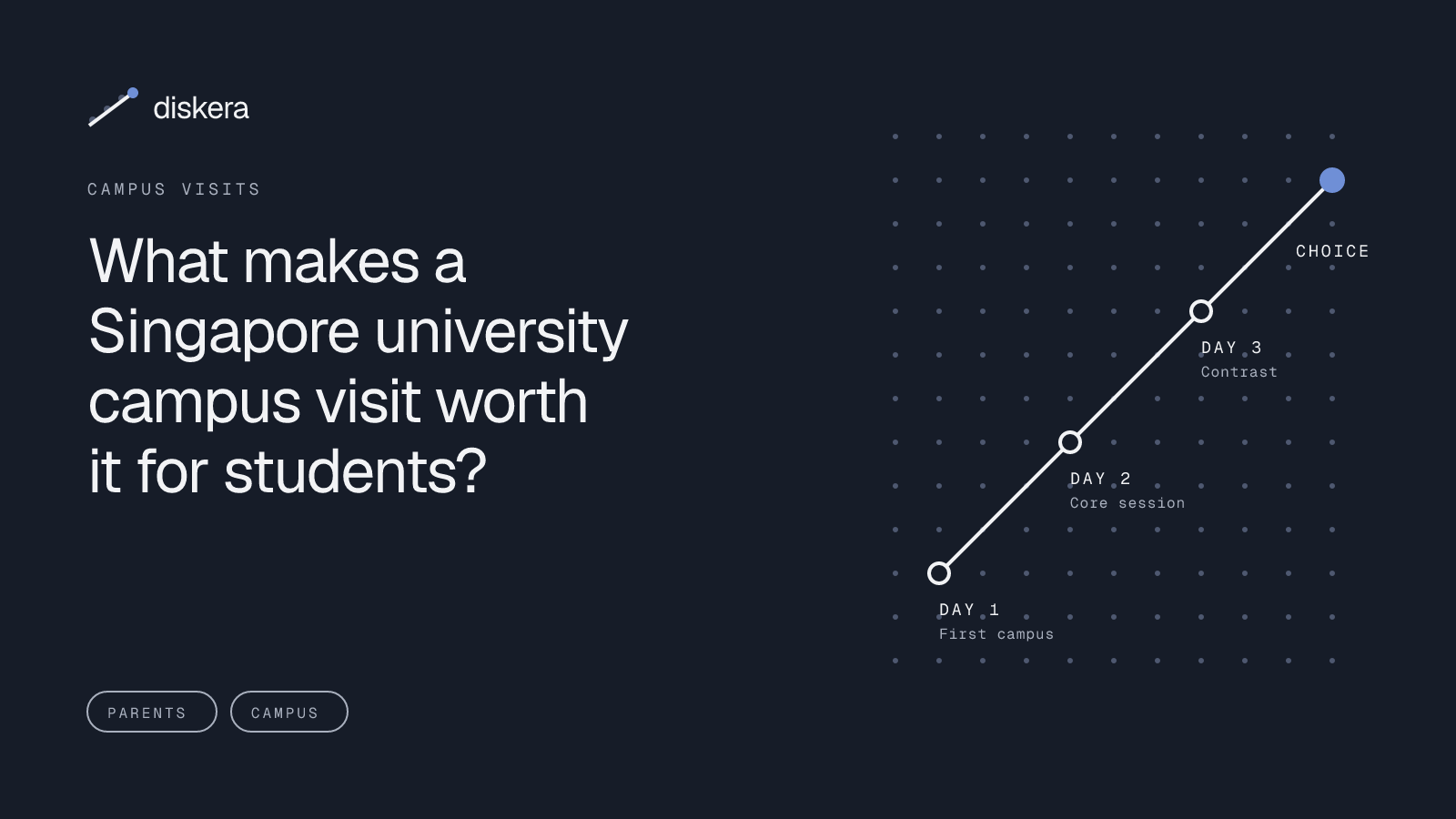
Three days is enough for two or three campuses without rushing. Below is an illustration of a sequence we think works for a school group. It is an example of structure, not a schedule confirmed by any university.
- 01
Day 1: first campus, gentle pace
After arrival and rest, the group visits one campus: a short presentation from the admissions team, then a walk with current students. The first day is deliberately light so students settle in.
- 02
Day 2: the core session at the second campus
The fullest day. One session with a faculty relevant to students' interests, time to question current students, and a look at facilities the host chooses to open to guests.
- 03
Day 3: a third campus or a deliberate contrast
A third campus gives a sharp comparison, for example a business-focused university after two research-led ones. The rest of the day is structured free time before departure.
The principle is contrast. Two campuses that feel alike leave students thinking they already know, when university choice turns on subtle differences in teaching, class size and learning culture.
Which campus rules should schools and parents know about?
Group visits must follow the host's rules, and our agendas are built within them. NUS's visiting guidance is a good picture of what campuses expect:
- Peak periods, roughly midday to 2.00pm and 5.00pm to 7.00pm, are best avoided because canteens and campus buses are crowded.
- NUS sets no age limit for visitors, but organisers must take responsibility for safety and supervision, especially with children or adolescents.
- Visitors are asked not to use loudhailers, and not to photograph or film students and staff without their consent.
- Restricted areas such as laboratories and hostels can be seen through NUS's 360-degree virtual tour. Entering them is possible only when the host arranges it.
Which students gain the most from a campus visit?
A campus visit is most valuable for students approaching a decision: the final years of secondary school, when subjects and countries are being weighed. For younger students the purpose differs. It is to spark curiosity and make studying abroad feel real, so the agenda should be shorter, more visual and more student-led.
For the wider evidence on whether programmes like this are worth it, read our piece on whether a study tour abroad is worth it for Indonesian students. The principle carries over: the value comes from how the programme is designed, not from the destination alone.
“The best visits leave students asking sharper questions, not just carrying home photos.”
What should you prepare before departure?
We handle the arrangements with each campus. On the school and family side, preparation is simple:
- 01
Define the learning goal
Tell us who is travelling, their ages and what students should come to understand. From there we choose the campuses and shape the sessions with each host.
- 02
Confirm travel documents
Check passport validity and entry requirements for each traveller's passport on the official Immigration & Checkpoints Authority (ICA) site. Prepare parental consent letters for minors.
- 03
Submit the SG Arrival Card
All travellers must submit it online within three days before arrival, counting the day of arrival. It is free, and ICA does not endorse paid services that offer to submit it for you.
- 04
Prepare students to ask
Have each student write three questions per campus before departure. Good questions make the session with the host far more useful.
What does a Diskera campus programme include?
Diskera designs and runs curated campus visits for schools and families. We can arrange visits to 280+ campuses and companies in 10+ countries, including hosts such as NUS, NTU and SMU in Singapore. The agenda is shaped around your group's goals, and we handle everything personally from departure to return, in comfort.
Learn more about Diskera Campus, or tell us what your group wants to achieve.
Plan a Singapore campus visit
Tell us your headcount, ages and learning goals. We will shape a curated agenda for your group.
Frequently asked questions
Do NUS, NTU and SMU accept school group visits?
Yes, but not by simply turning up. Each university has its own procedure for group visits, and public tours are designed for tourists. Because the rules change, we reconfirm every detail with the host before dates are fixed.
How many days should a Singapore campus visit take?
In our view three days is enough for two or three campuses without rushing. Anything longer is usually filled with industry sessions or other activities linked to students' interests.
Can younger students take part?
NUS states there is no age restriction for visitors, provided organisers take responsibility for safety and supervision. For younger groups we suggest a shorter, more visual agenda.
What documents do we need to enter Singapore?
Besides a valid passport, every traveller must submit the SG Arrival Card online within three days before arrival. It is free. Check visa requirements for your passport on the official ICA website before departure.
Can students see laboratories or hostels?
Those areas are generally closed to the public. NUS, for example, offers a 360-degree virtual tour instead. Direct access is possible only when the host arranges it as part of a session.
Sources
- National University of Singapore, “Q&A for Engagement Session on NUS Campus Tours” (2024)
- National University of Singapore, “Student-led guided tours” (accessed October 2026)
- Mothership, “NTU requires tour groups to register & pay entry fee after influx of tourists” (February 2024)
- NTU Office of Admissions, “Contact Us” (accessed October 2026)
- Singapore Management University, “Visit us” (accessed October 2026)
- Immigration & Checkpoints Authority Singapore, “SG Arrival Card” (accessed October 2026)