
Campus visits4 min read
Why are university campus visits abroad worth it for your students?
Because students choose better when they have stood inside the place. A curated visit to leading universities abroad turns a list of names into conviction, ambition and a clear next step.
By Tim Diskera
47.3%
of first-year US university students called a campus visit “very important” in choosing their college
HERI, UCLA, 2017
280+
campuses and companies we can arrange visits to
Diskera
10+
countries across Asia, Australia, Europe, the Middle East and North America
Diskera
Key takeaways
- Students make better university decisions when they have seen a campus from the inside, not just read about it.
- Nearly half of first-year students in a major US survey said a campus visit was very important in choosing their college.
- A curated programme gives students time with the people inside a university, which a sightseeing trip cannot.
- Seeing two or three contrasting campuses gives students a real basis for comparison and a sharper sense of where they belong.
- With Diskera, schools and families set the goals and we handle everything else, from departure to return.
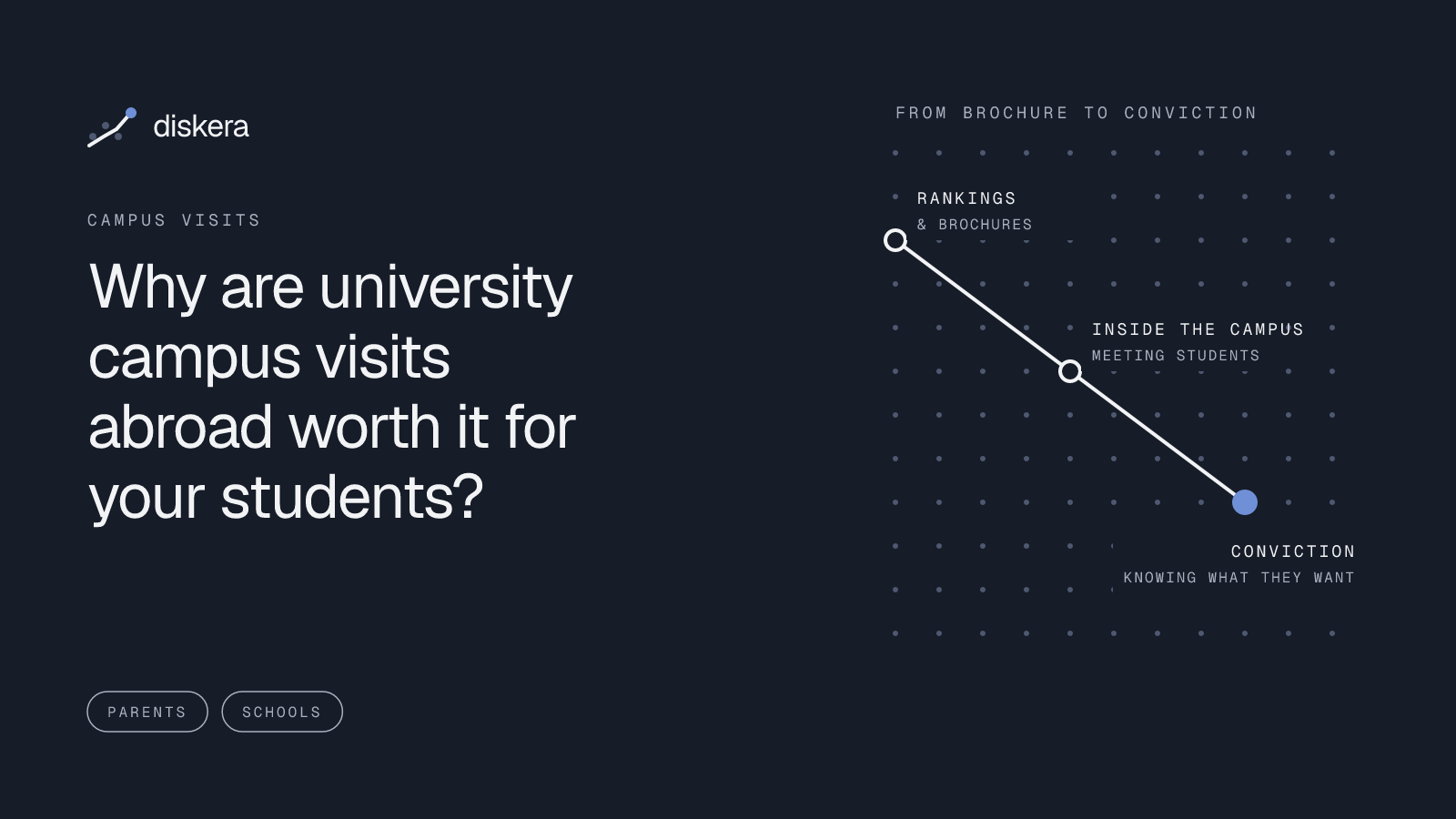
You want your students to choose a university with conviction, not on the strength of a ranking table or a glossy brochure. The surest way to get there is to let them stand inside the places they are considering and meet the people who study and teach there. University campus visits abroad do exactly that, and when the visit is curated well, students come home knowing what they want and why.
What do students actually gain from a campus visit abroad?
The value of a campus visit is not the photograph at the gate. It is what changes in the student afterwards. In our experience of designing these programmes, four gains matter most.
- Clarity: students see how a subject is actually taught and lived, and can tell which environment suits them.
- Ambition: a world-class university stops being an abstract name and becomes a real place they can picture themselves in.
- Confidence: talking with students and staff abroad makes studying overseas feel achievable rather than intimidating.
- Motivation: students return with a concrete goal, which gives the final years of school a sharper purpose.
Why does seeing a university from the inside change decisions?
Rankings measure research output and reputation. They say little about whether a particular student will thrive in a particular place: the size of the classes, the way seminars run, the culture on campus, the ambition of the people around them. Those things are felt, not read.
Students themselves recognise this. In UCLA's national survey of first-year university students in the United States, 47.3% said a campus visit was “very important” in choosing their college, up from 37.6% when the question was introduced in 2003. The visit has become one of the moments where a decision is actually made.
What separates a sightseeing trip from a curated campus programme?
Many trips abroad include a university on the itinerary. Few give students anything to decide with. The difference lies in access, in design and in who is looking after the group.
| Sightseeing trip | Curated Diskera programme | |
|---|---|---|
| What students see | Gates, landmarks and open grounds | The university as its students and staff experience it |
| Who they meet | Usually no one | People inside the university, chosen for the group's interests |
| How the agenda is built | Around attractions | Around what your students need to understand |
| How campuses are chosen | By fame or convenience | By contrast, so students have a real basis for comparison |
| Care for the group | Shared with many other travellers | Handled personally from departure to return, in comfort |
| What students bring home | Photos | Conviction about where they want to study and why |
Diskera's view of the two approaches.
The evidence on programmes abroad points the same way: the value comes from how the programme is designed, not from the destination alone. We look at that evidence in more depth in whether a study tour abroad is worth it for Indonesian students.
Which students benefit most, and when?
Indonesian students are already choosing universities abroad in large numbers. In 2024/25, 8,104 Indonesian students were enrolled in the United States alone, according to Open Doors. The question for most families and schools is not whether to look abroad, but how to choose well.
- Students in the final years of secondary school, who are weighing subjects and countries and need a real basis for the decision.
- Younger students, for whom an inspiring first look at a world-class campus can set an ambition that shapes the years ahead.
- International school cohorts, where a shared visit raises the ambition of a whole year group at once.
- Families comparing countries, who want to see Singapore, Australia, Japan or the UK side by side before committing.
What does the experience feel like for your students?
Picture a group of students sitting with undergraduates in Singapore and hearing, unfiltered, what a week of study is really like. The next day they are walking through a research-led campus in Tokyo, and by the end of the trip they are comparing the two with a precision no brochure could give them.
That is the experience we design. Universities we can arrange visits to include NUS, NTU and SMU in Singapore, the University of Tokyo and Waseda in Japan, Melbourne, Monash and UNSW in Australia, and Oxford, Cambridge and Imperial in the UK. For a closer look at one destination, read what makes a Singapore university campus visit worth it.
Some groups want to see where a degree leads, not only where it starts. A programme can pair campuses with leading companies, as in our guide to a study tour to South Korea that combines universities and industry.
“The best visits leave students asking sharper questions, and knowing which answers matter to them.”
What does a Diskera campus programme include?
Diskera designs and runs curated campus visits for schools and families. We can arrange visits to 280+ campuses and companies in 10+ countries, and every programme is built around one question: what should your students understand by the time they come home?
- 01
You tell us the goal
Who is travelling, their ages, and what they are trying to decide or discover.
- 02
We curate the campuses and the agenda
We choose universities that answer your students' questions and shape every session around them.
- 03
We handle everything
From departure to return, every arrangement is taken care of personally, in comfort, so teachers and parents can focus on the students.
- 04
Your students take it all in
They arrive curious, meet the people inside each university, and come home knowing what they want.
Learn more about Diskera Campus, or tell us what your students should come to understand.
Give your students a visit they will decide with
Tell us who is travelling and what they want to discover. We will curate the campuses and take care of everything else.
Frequently asked questions
Who is a Diskera campus programme for?
International and private schools, and families, whose students are weighing universities abroad or whom they want to inspire early. Programmes suit both groups from a single school and families travelling together.
How is this different from a regular study tour?
A regular study tour is usually built around sightseeing, with a university as one stop among many. A Diskera programme is built around what your students need to understand, with time alongside the people inside each university, and every detail handled personally.
Can the programme be tailored to our students' interests?
Yes, that is the point of it. We choose campuses and shape each session around your students' subjects, ambitions and the countries they are considering.
Which universities can students visit?
We can arrange visits to 280+ campuses and companies in 10+ countries, including universities such as NUS, the University of Tokyo, Melbourne, Oxford and Cambridge. Tell us your students' goals and we will recommend the combination that serves them best.
How do we get started?
Contact us with a rough idea of who is travelling, when, and what you want them to gain. We take it from there.